matcha supplier japan
How to Find a Matcha Supplier in Japan
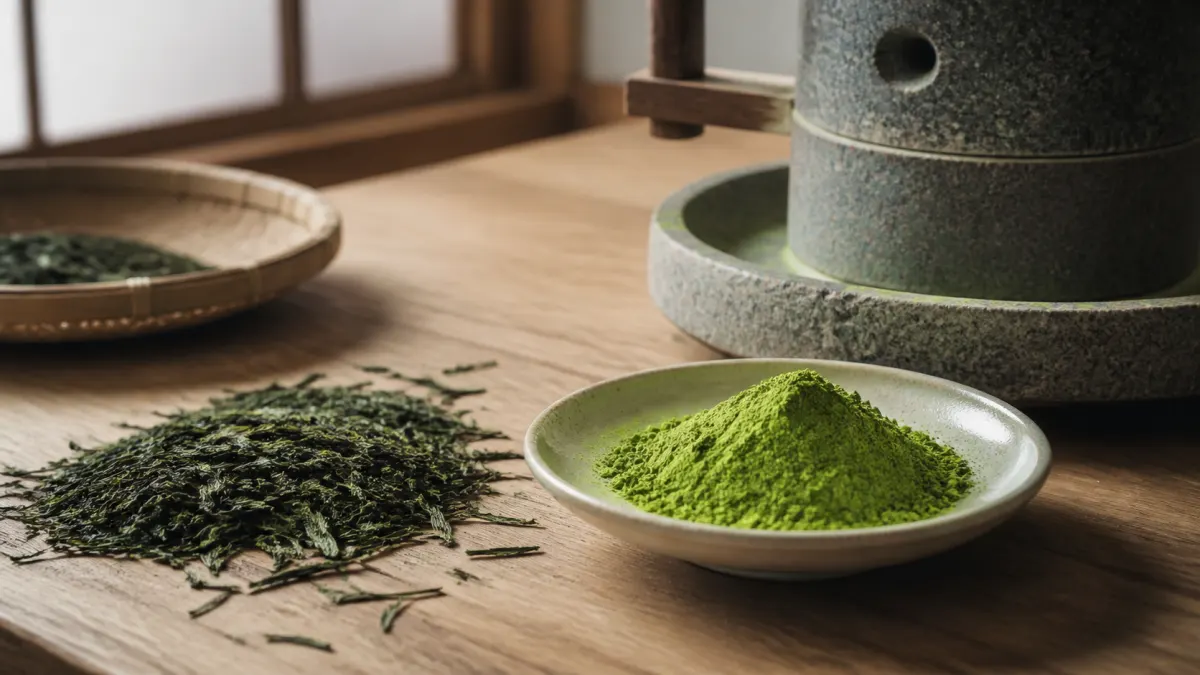
Matcha is currently the most requested Japanese sourcing category, and it is also the one where overseas buyers get burned most often. Demand has grown for five consecutive years against a raw material whose supply cannot expand quickly. That gap has produced allocation, steep price escalation, and a widening tier of resellers who present themselves as Japanese producers.
Know what you are actually buying
Matcha is made from tencha: tea leaves shaded for several weeks before harvest, steamed, dried without rolling, then stripped of stems and veins and milled into powder. Almost every quality variable is fixed before milling — cultivar, length of shading, harvest timing, and how thoroughly the stems and veins were removed. The mill determines particle size and texture, not the underlying quality.
"Ceremonial grade" is not a legal standard and not a Japanese industry standard. It is a Western marketing term with no certifying body and no defined threshold for anything. A supplier who sells you on the grade name rather than on harvest, cultivar and origin is selling you a label.
Ask instead for the things that can be verified: growing region and ideally the farm, cultivar, crop year, whether it is first flush, the shading period in days, whether it is stone-milled or ball-milled, particle size, and a colour measurement. A supplier who can answer all of these is doing the work. A supplier who answers "Japan, premium quality" is a trader who has not asked their own supplier.
Where matcha comes from, and what each origin means
| Region | Reputation | Practical note for buyers |
|---|---|---|
| Uji, Kyoto | The highest prestige and the strongest origin story | First-flush tencha yields fell sharply across the 2024–2025 seasons and auction prices rose steeply. Allocation is tight and pricing is the highest in the market. |
| Nishio, Aichi | Long-established matcha specialisation | A common and reliable source for mid-tier and volume grades. |
| Kagoshima | Modern, scaled, fast-growing production | Now a mainstream source for volume and organic matcha, and increasingly used to fill gaps left by Uji. |
| Shizuoka | Japan's largest tea-producing prefecture overall | Deep processing and blending infrastructure rather than a matcha-specific origin claim. |
| Yame, Fukuoka | Premium region, known for gyokuro | Small volumes, high quality, limited export capacity. |
A sourcing strategy that experienced buyers have converged on: reserve Uji for the premium SKUs where the origin is genuinely part of the product story and the price can carry it, and default to Kagoshima or Nishio for latte, culinary and ingredient tiers where the milk, sugar or batter will hide the nuance you paid for.
The supply reality you are buying into
- Tencha supply cannot be increased on demand. The bushes and the shading infrastructure take years to bring into full production, and only a limited number of growers do it well.
- Heat and irregular rainfall hit recent shading seasons, and top-grade Uji yields fell substantially.
- Auction prices for premium tencha have risen dramatically rather than incrementally.
- Established buyers hold the allocation. New accounts are served last, and in a shortage that means served little or not at all.
Red flag worth memorising: an unfamiliar supplier offering large volumes of premium first-flush matcha at short notice and below prevailing market price is describing a product the supply chain does not currently have. Assume blending, a later harvest, non-Japanese origin, or stock that does not exist, until documentation proves otherwise.
Four types of matcha supplier — pick the right one
| Type | What they do | Right for you if | Watch for |
|---|---|---|---|
| Tea farm or producer | Grows and processes its own leaf | You want traceability and a farm story at modest volume | Narrow grade range and often no export documentation capability |
| Tea wholesaler or processor | Blends and mills to a specification | You need lot-to-lot consistency more than a single-origin claim | Origin becomes "blended" — ask in writing what is in the blend and from where |
| Exporter or trading company | Handles export, documentation and consolidation | You have no Japanese entity and want one counterparty | Added margin, and they may decline to name the producer |
| Private-label packer | Fills your tins, sachets or pouches | You are launching a branded product | Packaging and tooling minimums sit on top of the tea minimum |
These are not mutually exclusive, and the mistake is assuming the cheapest quotation and the most traceable product can come from the same counterparty. They usually cannot.
Verification: what to demand before the first order
- Origin evidence traceable to region and, where the price implies it, the farm — stated with crop year and harvest.
- Residual pesticide testing against the standard of your destination market. EU maximum residue limits are stricter than Japanese limits for several active substances, and this is a common and expensive surprise at the border.
- Radioactivity testing where your market or your customers require it.
- Organic certification with the certificate number and scope, plus a Transaction Certificate covering your specific lot for JAS, USDA NOP or EU organic. An organic claim without a lot-level Transaction Certificate is not verifiable and is not defensible to your own customers.
- A full specification sheet: particle size, colour value, moisture, and any catechin or amino acid figures if you intend to make claims from them.
- Retained samples from the actual production lot rather than a showcase sample prepared for buyers.
The sample discipline that prevents most disputes is three-step: buy a paid sample, then place a small first lot, then verify that the lot matches the sample before committing to volume. Buyers who skip the middle step are the ones who later discover that the sample and the shipment were never from the same tea.
Price, minimum order quantity, and what drives cost
Published 2026 figures put direct-from-Japan Uji ceremonial-tier wholesale in the region of USD 250–500 per kilogram at minimums of roughly 10–25 kg, with volume and culinary tiers materially lower. Reported ranges vary widely between sources and are moving quickly in the current market, so treat any published figure as a reference point to negotiate against rather than a quotation.
- Harvest timing and shading duration, which set the raw material cost before anything else happens
- Region, which is partly quality and partly brand
- Milling method — a traditional stone mill produces on the order of tens of grams per hour, which is why genuinely stone-milled matcha cannot be cheap at volume
- Organic certification and the testing regime attached to it
- Packaging format, and whether nitrogen flushing and light-barrier materials are included
- Export handling, documentation and cold or controlled storage
If a quotation is priced per tin rather than per kilogram, convert it to per kilogram before comparing anything. Tin sizes are not standard, and the difference between a 30 g and a 40 g tin is frequently where a quotation stops being competitive.
The mistakes that cost the most
- Buying a ceremonial tier for a latte programme, and paying a large premium for characteristics that milk and sugar remove.
- Committing to a year of volume before seeing lot-to-lot consistency across at least two production lots.
- Skipping test certificates, then meeting your destination market's residue limits at customs rather than at the desk.
- Paying in full up front to a company whose corporate number you never checked.
- Assuming a Japanese company name means Japanese-grown leaf. Ask where the tea was grown, and get the answer in writing.
Want a verified matcha shortlist instead of a search results page?
GuideTech works from Tokyo. We identify candidate producers and wholesalers, make contact in Japanese, request specifications and certificates, check the company against Japanese public records, and hand you a shortlist with the trade-offs written down.
Frequently asked questions
Can I buy matcha directly from a Japanese farm?
Some farms export and are set up for it. Most are not: small producers rarely have the documentation capacity or the volume to serve an overseas trade buyer, so a wholesaler, exporter or Japan-side agent usually sits in between.
What minimum order quantity should I expect?
It varies enormously by tier. Specialists may sell high grades from a few kilograms, while volume and ingredient tiers commonly start at 25–100 kg or more. Private label adds separate packaging minimums on top.
Is ceremonial grade meaningless?
As a regulated term, yes — no body defines or certifies it. As industry shorthand for first-flush, stone-milled, drinking-grade matcha it is usable, but only when the supplier can support it with harvest, cultivar and origin.
How do I confirm the matcha is really grown in Japan?
Ask for origin documentation and crop year in writing, and use organic Transaction Certificates where they apply, because those are issued against specific lots and can be checked with the certifying body.